Loading content...
Backend
Node.js
Systems
Cloud
Architecting Scalable Microservices with Node.js

Lithin Kuriachan
Feb 1, 2025
12 Min Read
WRITTEN BY
Lithin Kuriachan
Tech Lead & ArchitectSHARE ARTICLE
Loading content...
In the modern landscape of software engineering, the transition from monolithic architectures to microservices is more than just a trend—it's a fundamental response to the demands of hyperscale, continuous delivery, and team autonomy. However, the path to a successful distributed system is fraught with complexity. Building scalable microservices requires a paradigm shift in how we think about data consistency, service boundaries, and failure modes. In this exhaustive deep dive, we'll explore why Node.js has become the backbone of modern distributed systems and how to navigate the intricate web of service discovery, asynchronous communication, and global scalability.
The monolithic approach—where the entire application logic, database access, and UI rendering are bundled into a single deployable unit—served the industry well during the early days of the web. It's easy to develop, easy to test, and straightforward to deploy. But as organizations grow, the monolith becomes its own worst enemy.
The challenges are systemic:
Microservices solve these by decomposing the application into small, independent services. Each service is organized around a business capability and is fully responsible for its own data and logic. This modularity is the key to unlocking "infinite" scale.
Why has Node.js emerged as a leader in this space? It's often misunderstood. People see "single-threaded" and think "slow." In reality, the single-threaded event loop is Node's greatest strength in a microservices environment.
Node.js excels at I/O-intensive tasks. In a microservices architecture, services spend most of their time waiting—waiting for a database query, waiting for an API response from another service, or waiting for a message from a queue. Traditional thread-per-request models (like early Java or PHP-FPM) would waste a whole thread just to wait. Node.js simply moves on to the next request, handling thousands of concurrent connections with a fraction of the memory.
Because Node.js processes are lightweight, you can pack hundreds of them into a single Kubernetes cluster. This granularity allows for extremely precise auto-scaling based on the specific load of each service.
Using JavaScript or TypeScript across the entire stack reduces the 'context switching' overhead for developers. Shared logic (like Zod schemas for validation) can be easily shared via private NPM packages.
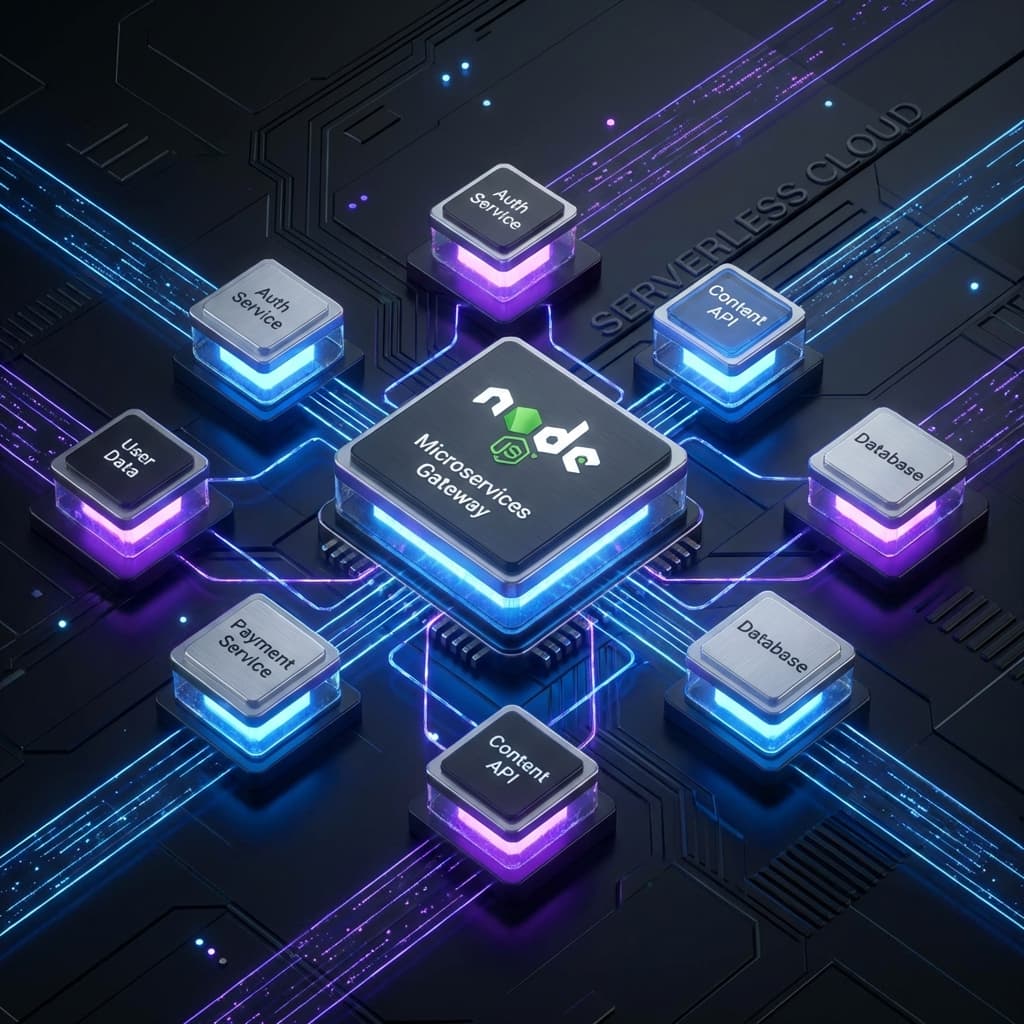
As your system grows to 50+ services, a standard API Gateway isn't enough. We often implement the **Backends for Frontends (BFF)** pattern. Instead of one giant gateway, we create small gateways tailored to specific clients (iOS, Android, Web). This prevents "leaky abstractions" where the frontend has to know too much about the internal microservice structure.
In a dynamic cloud environment, IP addresses are ephemeral. We use a **Service Registry** (like Consul or HashiCorp Vault) combined with **Sidecar Proxies** (like Envoy in an Istio mesh). This allows for "transparent" service discovery—Service A just calls `http://inventory-service`, and the sidecar handles the load balancing, retries, and mutual TLS (mTLS) encryption automatically.
If Service B is struggling, Service A should not continue to bombard it. This would lead to a "cascading failure." We implement a Circuit Breaker that monitors the error rate. If it exceeds a threshold (say 50% failures), the circuit "opens," and all subsequent calls are immediately failed with a fallback (e.g., returning cached data).
Synchronous REST calls are the "death by a thousand cuts" of microservices. They create temporal coupling—Service A cannot work unless Service B is up. The solution? **Eventual Consistency** through an Event Bus.
Using Apache Kafka or RabbitMQ, we move from "telling services what to do" to "announcing what happened."
One of the hardest parts of microservices—and often where systems fail—is data management. In a monolith, you have ACID transactions. In microservices, you have a distributed mess.
The golden rule of microservices is that each service should have its own private database. No other service should access its data directly. If Service A needs data from Service B, it must ask through an API. This ensures that you can change the schema of Service B without breaking Service A. It also allows you to choose the right database for the job: MongoDB for a flexible product catalog, PostgreSQL for structured order data, and Redis for high-speed session management.
When your data is split across 20 databases, joining data becomes impossible. Enter **Command Query Responsibility Segregation (CQRS)**. We split the "write" side from the "read" side. The Write Service handles commands (like "Place Order"), while a separate Read Service maintains a "view" of the data optimized for queries.
Combined with **Event Sourcing**, where we store the entire history of events rather than just the current state, we can rebuild our entire system state from scratch just by replaying the event log. This provides an incredible audit trail and the ability to perform time-travel debugging.
We use **Sagas**. A Saga is a sequence of local transactions. If one fails, the Saga must execute "compensating transactions" to rollback the change.
In a monolith, you look at one log file. In microservices, a single user request might span 20 services across 5 different countries. Without **Distributed Tracing**, you are flying blind. We use Trace IDs embedded in HTTP headers. Tools like Jaeger or Honeycomb allow us to see a "waterfall" view of the entire request lifecycle, identifying exactly which service is the bottleneck.
Integration testing in microservices is notoriously difficult. If you try to spin up all 50 services to test one, you'll spend more time fixing your test environment than writing code. The answer is **Consumer-Driven Contract Testing (Pact)**. The consumer (Frontend) defines what it expects from the producer (Backend). Both are tested against this "contract" independently, ensuring they never break each other.
In a microservices world, you cannot assume that traffic inside your network is safe. We adopt a **Zero Trust** architecture. Every internal call must be authenticated and authorized. We use JWT (JSON Web Tokens) for user identity and mTLS for service identity. This ensures that even if one service is compromised, the attacker cannot easily move laterally through the system.
We are moving towards a world where we don't even manage the "service" anymore. AWS Lambda or Google Cloud Functions allow us to write "Nano-services" that only run when needed. Combined with Edge Computing (running logic on CDN nodes), we can now deliver microservices with sub-50ms latency globally.
Microservices are an organizational solution as much as a technical one. They are about allowing teams to move fast without stepping on each other's toes. If you are a team of three building a MVP, stay with a monolith. But if you are building the next global platform, microservices—powered by Node.js—are your ticket to the future.
The journey to microservices is a marathon, not a sprint. Start with a modular monolith, identify your boundaries, and decouple with intent.